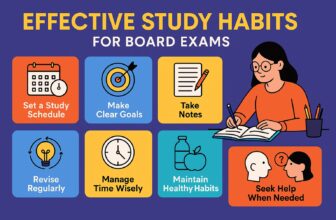

A student sits with a chapter for three hours. She reads it twice, highlights the important lines in yellow, and copies a few definitions into a notebook. By the time she shuts the book, the material feels familiar. The next morning, a friend asks her to explain the same chapter out loud, and she stumbles. Half the details are gone. This happens to millions of students every exam season, across CBSE, ICSE, and state board classrooms. And it isn’t because they didn’t try hard enough. It’s because time spent studying and actual learning are not the same thing. You can sit with a book for four hours and retain very little, or study with focus for ninety minutes and remember most of it weeks later. The difference isn’t effort. It’s method.
The Real Problem: Passive Studying Feels Like Learning, But Isn’t
Rereading notes, highlighting textbooks, and watching recorded lectures on repeat all share one flaw: they make information feel familiar without testing whether you can actually produce it from memory. This gap has a name in cognitive psychology — the difference between recognition and recall. When you reread a page, your brain recognises the words and ideas because you just saw them minutes ago. That recognition creates a comfortable feeling of “I know this.” But recognising something on a page is a completely different mental skill from recalling it with a blank page in front of you, which is exactly what an exam demands.
A widely cited memory study found something striking about this gap. Students who read a passage once and then tested themselves by trying to recall it, without looking back, remembered far more of it a week later than students who reread the same passage multiple times — even though the rereading group had spent more total time with the material and felt more confident about it. Confidence and correctness were pulling in opposite directions. This is the trap. Highlighting and rereading are easy, low-effort activities that feel productive because they’re smooth and comfortable. Actual learning is supposed to feel a little difficult. If studying never feels like effort, it’s often not doing much.
The Three Techniques Backed by Learning Science
Cognitive science has tested many study methods over the decades, and three consistently outperform the rest for long-term memory. None of them require special apps or expensive coaching. They require a change in habit.
- Active recall (retrieval practice) means trying to remember information without looking at the source. Close the book, and ask yourself: what were the three causes of this event? What is the formula for this, and when do I use it? If you can’t answer, that’s useful information — it tells you exactly what to restudy, instead of wasting time rereading material you already know.
- Spaced repetition means reviewing the same material more than once, with gaps of days or weeks in between, rather than covering it once and moving on, or cramming it all the night before an exam. A topic studied today, revisited briefly after two days, then again after a week, sticks far better than the same topic studied for three straight hours in one sitting.
- Practice testing means using actual questions — from your textbook, previous year’s papers, or ones you write yourself — to check what you know, instead of assuming you know it because the chapter looked familiar. This is different from active recall in one useful way: it forces you to apply the concept to a slightly new situation, not just repeat a definition.
Put together, these three form a simple loop: learn something, try to retrieve it without help, space out your reviews, and test yourself with real questions. That loop, repeated across a term, beats hours of passive rereading.
How to Tell If You Actually Learned Something
Feeling ready is not the same as being ready. After finishing a topic, ask yourself four questions: Can I explain this without looking at my notes? Can I answer a question about it that isn’t worded exactly like the textbook? Can I say precisely where I’m still confused, instead of a vague “I sort of get it”? Can I apply this concept to a new problem I haven’t seen before? If the honest answer to any of these is no, that topic isn’t done — no matter how many times you’ve read it. These four questions are a better test of learning than the comfortable, familiar feeling of having “gone through” a chapter.
When Studying Alone Isn’t Enough
Sometimes the problem isn’t the study method — it’s a gap in the basics that active recall alone can’t fix. If a student keeps forgetting the same topic despite retrieval practice and spaced review, it often means an earlier concept was never fully understood in the first place, and no amount of self-testing on the current chapter will fix a crack from two chapters ago. This is where a second pair of eyes helps. A good home tutor or subject-specific tutoring can identify exactly which foundational gap is causing the trouble, explain it at the student’s own pace, and adjust the pace of self-study accordingly — something a student rarely has the distance to do for themselves. This matters especially around board exam preparation, where a small unresolved doubt from an earlier chapter tends to resurface, uninvited, in a later one.
Why Forgetting a Little Isn’t Always Bad
Here’s the part most students get backwards. If you review a topic again right after learning it — same day, same session — your brain doesn’t have to work to bring it back. It’s still sitting right there in short-term memory. There’s very little benefit to reviewing something you haven’t had a chance to forget yet. But if you wait a day or two, some of that information genuinely fades. Now, when you try to recall it, your brain has to work harder to reconstruct the memory. That extra effort is what strengthens the memory trace for next time. This is why a slightly-too-late review, one where you have to struggle a bit to remember, often teaches you more than a slightly-too-early review where recall feels effortless. This doesn’t mean forgetting is good, or that you should deliberately let things slip for weeks. It means a short gap between learning and reviewing — a day, not a month — is often more useful than reviewing immediately.
Stop Studying Every Subject the Same Way
A method that works for one subject can be nearly useless for another.
- For Mathematics, rereading solved examples teaches you very little. Cover the solution, attempt the problem yourself, and only check the method after you’re stuck or done. The struggle is where the learning happens.
- For Science, explaining a concept out loud in your own words — to yourself, a sibling, or an empty room — exposes gaps that rereading never will. Follow it up with a diagram from memory and an application-based question, not just the definition.
- For History and Social Science, isolated facts fade fast. Connecting causes to consequences, and linking one event to the next, gives your brain a structure to hang details on, instead of a pile of disconnected sentences to memorise.
- For languages, reading alone won’t build recall. Mix reading with writing from memory, retrieving vocabulary without a list in front of you, and correcting your own mistakes — that combination sticks far longer than repeated reading.
What a Genuinely Effective Two-Hour Study Session Looks Like
You don’t need an elaborate timetable. You need a sequence. Spend the first 30–40 minutes learning new material — reading the chapter, watching the lecture, understanding the concept properly. Then close the book completely. Spend the next 15–20 minutes writing down or saying out loud everything you remember, without checking. Open the book and compare — where did your memory fail? Spend the next 30 minutes working through practice questions on the topic. Finally, spend the last 15–20 minutes going back specifically to the points you got wrong or forgot, not the ones you already know well.
Learn, close the book, recall, practise, check mistakes, revisit the weak spots. That sequence, done for two focused hours, will usually beat four hours of straight reading.
Concentration, Phones, Breaks, and Sleep
Technique alone doesn’t work if attention keeps breaking every few minutes. Every time you check a phone notification mid-topic, your brain needs time to refocus — often several minutes — which means a two-hour session interrupted twenty times isn’t really two hours of study at all. Short, planned breaks — five to ten minutes after 40–50 minutes of focused work — tend to help sustain attention better than either no breaks or constant, unplanned ones. And sleep is not optional background noise here: memory consolidation, the process by which what you studied during the day gets stored for the long term, happens largely during sleep. Cutting sleep to squeeze in extra late-night revision often backfires — you retain less of what you crammed, and you’re too tired the next day to learn new material properly. No study technique, however good, fully compensates for chronic sleep loss or constant phone distraction. They work together, not as substitutes for each other.
Study Smarter, Not Simply Longer
More hours with a book do not automatically produce more learning. What produces learning is retrieval — trying to remember, testing yourself, spacing out your reviews, and returning honestly to what you got wrong. Protecting sleep and concentration isn’t a side habit; it’s part of the same system. After your next study session, close the book and try to explain, out loud, what you just learned — without looking. That one habit, repeated daily, will teach you more about your own preparation than any amount of rereading ever will.
Frequently Asked Questions
Most forgetting happens because rereading builds recognition — a sense of familiarity — rather than recall, the ability to retrieve information without help. Recognition fades fast unless it’s converted into recall through active retrieval and review.
Active recall means trying to remember information from memory, without looking at your notes, instead of rereading the source. It’s the mental equivalent of a self-test, done as part of studying rather than only during exams.
Spaced repetition means reviewing the same topic more than once, with gaps of a day, then a few days, then a week, instead of studying it once or cramming it all the night before. A simple version: revisit today’s topic briefly after two days, then again after a week.
Rereading makes text feel familiar, and that familiarity is mistaken for knowledge. But recognising a sentence on a page and being able to produce that same information from memory, unaided, are two different skills — and exams test the second one.
There’s no fixed number that works for everyone, and more hours don’t guarantee better results. What matters more is whether those hours include active recall, spaced review, and practice questions — a focused two hours using this loop can outperform four hours of passive rereading.
Yes, but the specific format changes by subject — solving problems unaided for Maths, explaining concepts aloud for Science, connecting cause and effect for History, and combining reading with writing for languages. The underlying principle of active retrieval stays the same.
When the same topic keeps getting forgotten despite genuine retrieval practice and review, the issue is often a gap in an earlier foundational concept rather than a lack of effort. A tutor can pinpoint that gap and explain it at the student’s pace, which self-study alone often can’t do.
Next Reading: Scoring Better Marks in Exams