The academic year 2026-27 marks the most comprehensive structural overhaul to the Central Board of Secondary Education (CBSE) in over a decade. Driven by the phased rollout of the National Education Policy (NEP 2020) and the National Curriculum Framework (NCF), CBSE is transitioning away from traditional testing toward skill-based, internationally aligned education. For parents of students in Classes 9, 10, 11, and 12, understanding these shifts in CBSE Exam Pattern 2026-27 is critical. Navigating the changes requires a close look at the official 2026-27 guidelines, structural updates, and grading systems.
1. The Core Philosophy: Shifting to 50% Competency-Based Learning
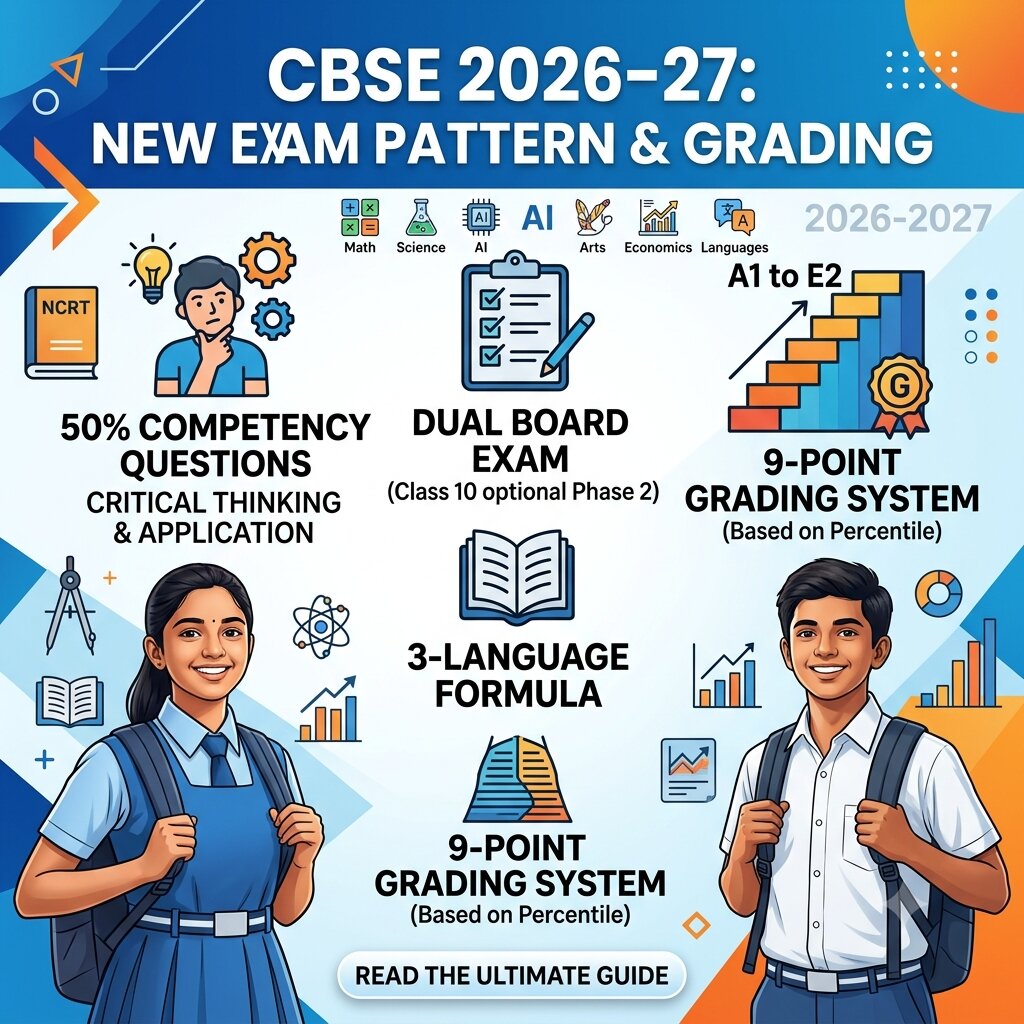
The era of memorizing textbook answers the night before an exam to score a perfect 95% is officially over. For the year-end board examinations, CBSE has permanently restructured the weightage of question papers. Across Class 10 and Class 12, 50% of the total theory marks are allocated to Competency-Focused Questions.
The 2026–27 Board Exam Question Blueprint:
- Competency-Focused Questions (50%): These take the form of real-life case studies, source-based integrated questions, data interpretation scenarios, and assertion-reason matrices. They evaluate a student’s capacity to apply theoretical definitions to unfamiliar real-world situations.
- Objective Questions (20%): Standard Multiple-Choice Questions (MCQs) designed to test rapid conceptual clarity.
- Constructed Response Questions (30%): Traditional short-answer and long-answer descriptive questions. This is a noticeable reduction from older formats where long descriptive answers dominated the paper.
2. Breaking Down the New Three-Language Formula (R1, R2, R3)
Starting with the 2026–27 academic session, a mandatory Three-Language Framework is implemented for secondary education.
- The Native Rule: Students must study three languages, and at least two of them must be native Indian languages (designated as R1 and R2).
- The Categorization of English: English is classified under the foreign language/elective bracket for the third language slot (R3). If a student chooses English, it satisfies the R3 criteria, provided they are already taking two native Indian languages (such as Hindi, Sanskrit, Tamil, or Telugu).
- The Launch Timeline: The first full batch to sit for a unified 3-language board exam will graduate in 2031. However, the operational textbooks and curriculum tracking for the third language are active for Class 6 and entering Class 9 students starting this year.
3. The 9-Point Grading Scale Explained
To reduce hyper-competitiveness and ensure an equitable evaluation across diverse regions, CBSE uses a strictly normalized 9-Point Grading System. Rather than reflecting raw percentages directly, the final board certificate maps grades based on relative positioning among passing candidates.
| Percentage / Marks Range | Grade | Grade Points | Algorithmic Distribution Criteria |
| 91 – 100 | A1 | 10.0 | Top 1/8th (12.5%) of the passed candidates |
| 81 – 90 | A2 | 9.0 | Next 1/8th of the passed candidates |
| 71 – 80 | B1 | 8.0 | Next 1/8th of the passed candidates |
| 61 – 70 | B2 | 7.0 | Next 1/8th of the passed candidates |
| 51 – 60 | C1 | 6.0 | Next 1/8th of the passed candidates |
| 41 – 50 | C2 | 5.0 | Next 1/8th of the passed candidates |
| 33 – 40 | D | 4.0 | Next 1/8th of the passed candidates |
| 21 – 32 | E1 | 0.0 | Required to reappear / Essential Repeat |
| 0 – 20 | E2 | 0.0 | Required to reappear / Essential Repeat |
Critical Warning for Parents: Internal assessments now carry a strict compliance clause. If a student misses mandatory internal projects, practical labs, or periodic assessments conducted between January and mid-February, they will be marked as “Essential Repeat”, rendering them ineligible to sit for the end-of-year theory board exams.
4. Radical Subject Flexibility & The Removal of Stream Barriers
The rigid boundaries separating Science, Commerce, and Humanities are being dismantled. The 2026–27 curriculum gives schools the framework to offer interdisciplinary subject choices, allowing students to build unique learning profiles based on their specific career goals.
- Custom Combinations: A student can choose Physics with Economics, Mathematics with Political Science, or Biology with Psychology.
- Advanced Tiers in Class 9: CBSE has rolled out optional advanced-level modules for Mathematics and Science starting in Class 9. Students can opt into these advanced tracks to prepare for highly technical fields without negatively impacting their overall aggregate score if they find it too demanding.
- Compulsory AI & Tech Integration: Computational Thinking (CT) and Artificial Intelligence (AI) are formal, compulsory modules. AI transitions into a fully assessed board-level examination subject by 2029.
5. Dual Board Exam Opportunities
For Class 10, the “one-shot, high-stress” testing model has shifted. Class 10 board exams are split into two distinct periods within a single academic year:
- Phase 1 (February): The mandatory core testing phase covering the entire syllabus.
- Phase 2 (May): An optional second session. Students who cleared Phase 1 but wish to improve their scoring can choose to re-sit exams for up to three subjects. The board automatically recognizes the higher of the two scores for the final grade sheet.
6. How Parents Can Help Their Children Adapt
Because half of the exam questions test practical application rather than memorization, typical textbook review routines are no longer enough.
- Prioritize “Why” Over “What”: When your child completes a chapter, challenge them with situational problems. Do not just ask them to state a scientific law—ask them how that law explains a device or scenario in their home.
- Focus on Case Studies early: Utilize updated sample question banks that feature comprehensive data interpretation and assertion-reason question formats.
- Consider Individualized, Application-Based Mentorship: Traditional classroom environments with dozens of students face structural limitations when trying to guide every individual through analytical thinking. Personalized, one-on-one home or hybrid tutoring programs can fill this gap, helping students develop the conceptual habits needed to navigate CBSE’s new framework.
Need help adapting to the new CBSE 2026-27 Competency Syllabus?
Don’t wait until the board exams arrive. Connect with verified, local home tutors who specialize in application-based learning, competency questions, and the updated NCERT curriculum guidelines.